The Post Office
By James Langton · Updated September 2026
Post Office Row
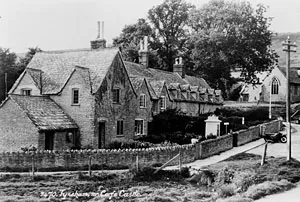
As you walk up from the car park towards the church, look for the terrace of four roofless cottages on your left. This is Post Office Row, "The Row" to the people who lived in it, and the post office was the third of the four cottages, counting from the church end. The terrace was built around 1850 and originally thatched; the roofs were replaced with stone tiles in about 1880.
Each of the four homes had its own character. No. 1 was the school house, where the schoolmistress lived. No. 2 was a labourer's cottage. No. 4, at the far end, went by tradition to the village shepherd. No. 3, third in from the church, was the shop from 1880, adding the duties of a post office from 1890.
The Army stripped the roofs off the row for safety and capped the walls, so today these are empty stone shells. Each one carries an information board with photographs of the families who lived there. Take the walk slowly. Plain as they look, these four cottages were where the village actually lived.
The village shop
The shop was never big. Three customers at a time produced a traffic jam, and when the counter was piled high with parcels waiting for the postman, the postmistress was barely visible behind it. Lilian Bond, who grew up at Tyneham House, remembered the scene in detail:
The shop had a fine, rich blend of smells, bacon and cheese predominating, with alluring under-currents of tea, liquorice and peppermint. A big cardboard box displayed needles and thimbles, cotton reels, mending wool, buttons and tape, all priced at a copper or two.
Alongside the groceries went flour and soda in sacks stacked on the floor, candles, paraffin and tobacco, and in later years the village's ration books. Helen Taylor, whose family lived at the laundry cottages, watched Mrs Barnes take over and wondered where it would all end:
It was hardly big enough, what with parcels waiting to be collected, bags of flour and soda having to be stacked upon the floor and all the provisions Mrs Barnes was required to stock. Business was brisk indeed, but I wondered whether we should soon not be able to get into the shop for clutter.
The shop doubled as the village's social room. News, gossip and messages all travelled through No. 3. And, as the writer Patrick Wright noted, you could leave a parcel at the roadside and be confident it would still be there when the person it was for came up the field track to fetch it.
The post office and the mail
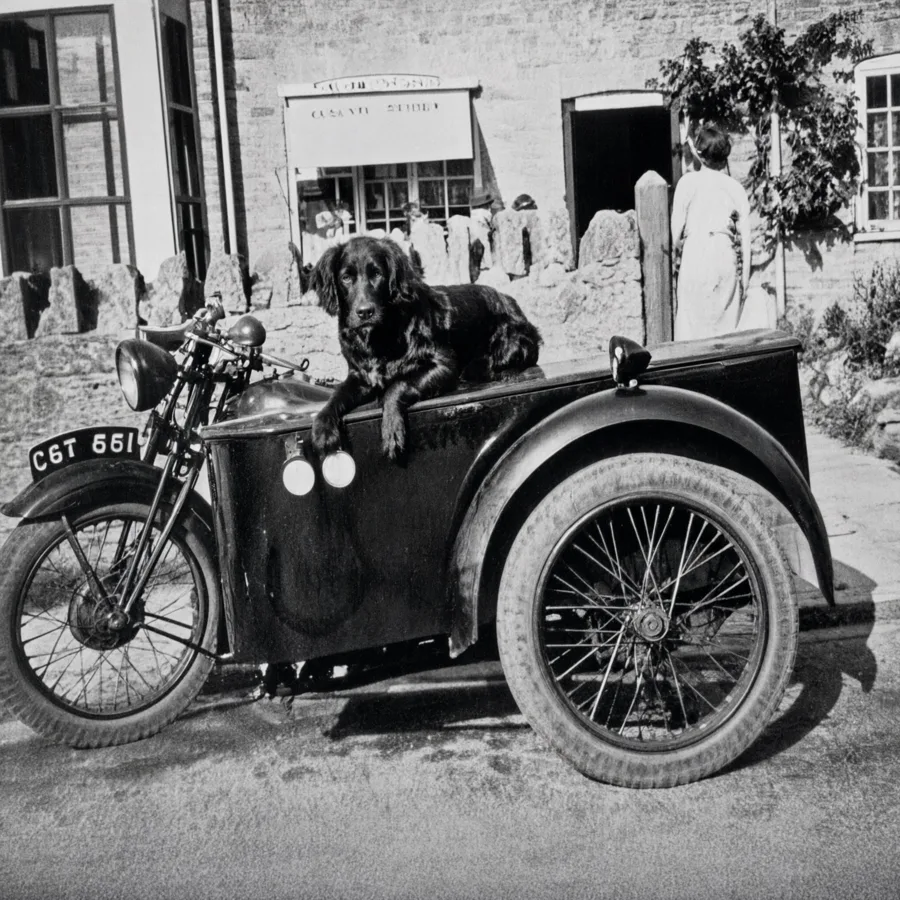
The mail arrived by motorcycle. A postman rode out from Wareham, delivered the incoming post, collected the outgoing, and for years did the round with his dog beside him in the sidecar. Colin Driscoll, whose family kept the post office from 1938, remembered when things got properly official: "In 1940 his sidecar was upgraded to a proper Post Office Van."
Colin's sister Joan was the post girl. At sixteen she was out delivering letters and telegrams across the valley, and she knew absolutely everybody. She later trained as a nurse and was sent to the front line with the 14th Army.
The post office's own telephone, the first in the village, lived in the kitchen for the sake of privacy. It could only send and receive telegrams, and privacy was a forlorn hope. Lilian Bond again: "Mrs Pitman's voice repeating messages could be distinctly heard by customers in the shop. The substance of incoming telegrams was often known all round the village before they reached their lawful destination."
A postman finally closed the story. On 17 November 1943, the Creech village postmaster delivered to every household in Tyneham the letters that brought the news: the valley had been requisitioned, and the villagers had until 19 December to leave. They never came back.
Shopkeepers and sub-postmasters
A succession of families ran No. 3 between 1880 and the evacuation:
- 1880–1890: William Mores (shop only)
- 1890–c.1905: Mrs Anne Mores, his widow (post office from 1890)
- c.1905–1910: Mrs Emma Jane Pitman (née Tizzard)
- 1910–1915: Harry Barnes
- 1915–1938: Mrs Edith Barnes, later Mrs Edith Herd
- 1938–1943: Mrs Gwendoline Driscoll
William Mores and his sons ran the shop in the early days. One son was the village baker, another worked as under-gardener at the House, and when the family left there was no successor in the bakery, so bread began to come over from Corfe in a delivery van.
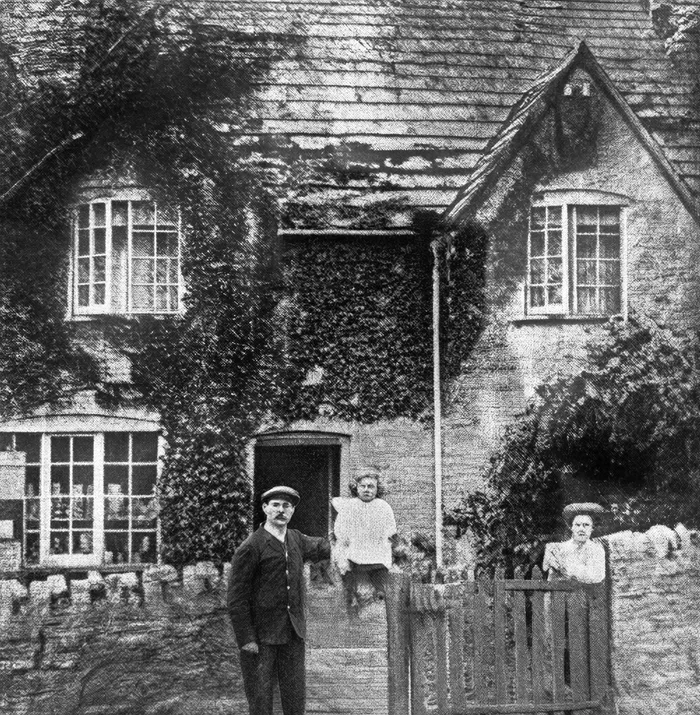
Harry Barnes had seen the world before he came to Tyneham: a gunner in the Royal Garrison Artillery, he served in Hong Kong, Singapore, Gibraltar and Sierra Leone before being discharged medically unfit in 1905. He married Edith Knight, whose father ran the sub-post office at East Lulworth, and together they took over No. 3. Harry died in 1915, and Edith carried on alone through the 1930s, remarrying in 1920 to become Mrs Herd. For about a year somewhere along the way, a William Hart ran the post office too.
By the time the Bond family's long reign at Tyneham was coming to an end and war was closing in, the shopkeeper's role had passed to a new family, the Driscolls, and it is their story that lingers longest.
Tyneham's last postmistress
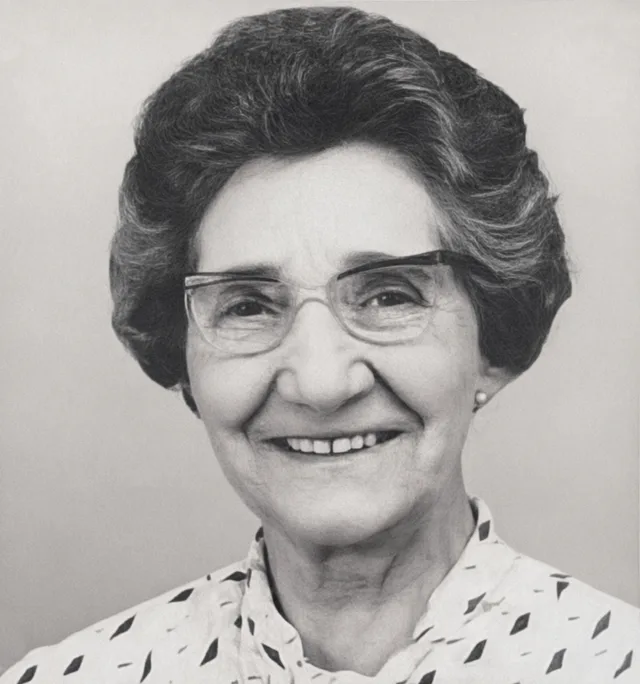
Gwendoline Driscoll was Tyneham's last postmistress, and her own life was as eventful as any villager's. She was born Gwen Hall in 1897 in South Wales, working as a booking clerk at Senghenydd station before the First World War. Her husband William was Irish, born at Tallow in County Waterford. He had run away from home as a boy, worked as a pit boy in the Welsh coal mines, and enlisted in the Rifle Brigade in 1914, rising to sergeant and winning the Distinguished Conduct Medal.
The family arrived in Tyneham in 1938, when Gwen took on the post office and shop, and they stayed at No. 3 until the evacuation. Their four children grew up in the cramped rooms above the shop. The oldest, Betty, met a young soldier guarding the coast, Dugg Duggleby, right there in the post office in 1940. Joan, the second daughter, was the post girl, delivering the mail from the age of sixteen. The two youngest, Peter and Colin, were sent to fetch water from the church tap every morning:
With no piped running water in Tyneham my brother Peter and I had the daily chore to collect drinking water from the Tap by the church, but Mondays, with the main wash to be performed, it was a fairly substantial number of buckets to be carted to fill the copper boiler and still be ready to catch the School Bus.
After the evacuation the family scattered. Gwen worked in a grocery in Corfe Castle, then became sub-postmistress at Kimmeridge. In 1964 William died, and Gwen emigrated to Rhodesia, where she died in 1975. Peter went on to a military career and reached the rank of lieutenant colonel. In 1982, he and Colin came back to Tyneham to see the old post office garden.
The telephone kiosk
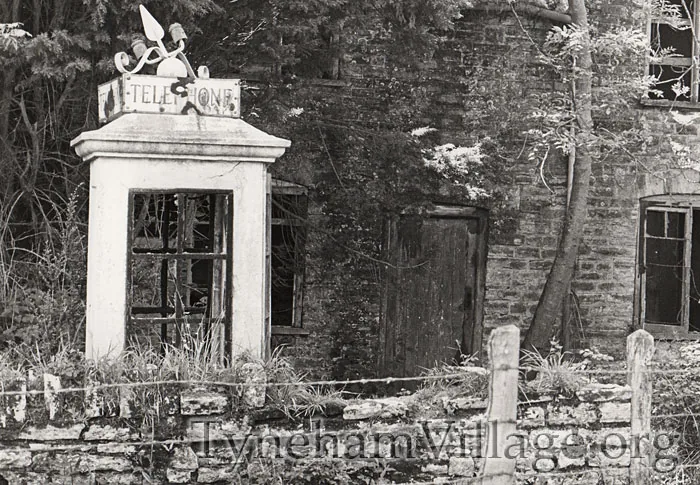
The white concrete box that still stands outside No. 3 is a K1 kiosk, one of only a handful left anywhere in Britain. It arrived in the winter of 1929, over the objections of the squire, William Bond, who held off the modern world as long as he could. Inside, a wartime notice asks callers: "I am on war work. If you must use me, be brief."
It deserves a page of its own, and we'll be writing one. For now, the short version: the kiosk survived the evacuation, was destroyed in an accident during the making of Comrades in 1985, and was carefully restored in 2012 with the help of a retired GPO engineer. It is locked, disconnected and has not rung since 1943, which has not stopped more than one visitor from swearing they heard it ring.
After the evacuation
The post office died with the village, but not quietly. In August 1973, with the campaign to win Tyneham back at its height, campaigners briefly reopened it. John Gould, born in the gardener's cottage in 1912, sent the first postcard from the reopened post office. Mavis Caver mounted a homemade pillar box on a post, and when the police came to remove it she stood her ground and told them to leave it alone; it was her property. They very nearly all ended up in the Black Maria.
Two years later, in 1975, range wardens were demolishing an old corrugated iron shed at the back of the post office when they found a pile of villagers' Second World War ration books, thrown there in 1943 and left for 32 years. Names like Everett, Longman, Driscoll and Holland were still legible on the orange and buff counterfoils. The warden who found them, Jane Cato, cleaned them up and hoped to put them on show in the church.
The ration books say something about how Tyneham ended. The villagers took almost everything with them when they left, down to the last used-up coupon. What they left behind was a shop that had stood at the centre of village life, and a pile of paperwork at the back of it.
The post office today
The ruins of No. 3 and its neighbours are still there, roofless and open to the sky, with an information board outside telling the families' story. The K1 kiosk still stands in its original spot, and most visitors walk straight past it on the way to the church; now you'll know what you're passing. For opening times and directions, see our guide to visiting Tyneham.