Tyneham Farm
By James Langton · Updated June 2026
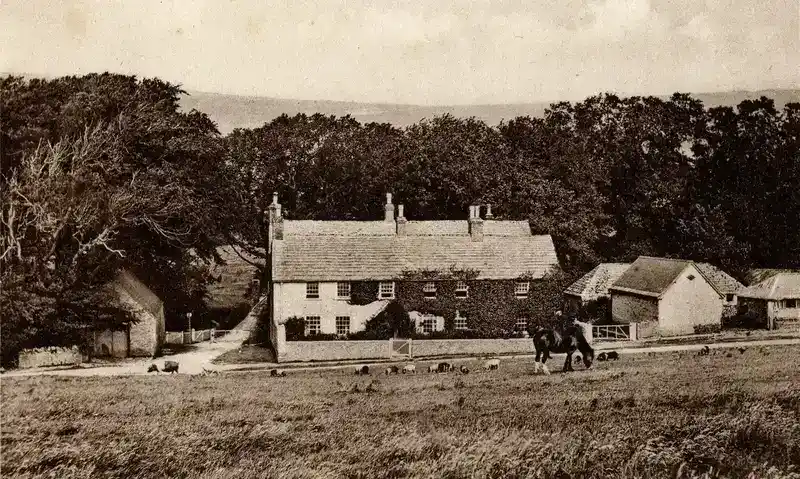
The farm that served Tyneham for over a century
Tyneham Farm stands about 300 metres south of the village centre, down the lane past the church and through the old gateway. Of the original farm complex (farmhouse, dairyman's house, barns, stables, and outbuildings), only the granary, the stable block with its carthorse stalls, and the Great Barn survive in any completeness. The farm was the economic heart of the Tyneham estate for over a century, and it is also, unexpectedly, the place in the village that most makes visitors feel as if everyone just upped and left.
The farm had two lives that visitors still encounter. The first was agricultural, the estate's working farm, with its cheese dairies, its Dorset Horn sheep, and, in its final years, the first tractors the valley had seen. The second was as a theatre: from around 1899 to 1914, the Great Barn staged the village's theatrical productions, and in 2009 a stage was rebuilt in the barn for the first show Tyneham had seen in ninety-five years.
The Farmers: Smith and Churchill
The farm was run by the Smith family from 1902, when Walter Case Smith (1861–1948) took it over and held it until 1940. Walter ran a substantial operation, 500 acres carrying a flock of Dorset Horn sheep, a large herd of dairy cows, and wide areas of cereals. The evening's milk was collected at 8 a.m. the next day. There was no laid-on water, electricity, or sewerage; in summer the large cheese churns were left overnight in the stream to keep cool.
"Uncle Walter certainly had no tractors when he left in about 1940. When a new tenant arrived, (Mr. Churchill), much consternation was caused by his introducing tractors and sacking some of the men."
In 1940 the tenant changed. Sydney George Churchill (1900–1975) took over and kept the farm going through the first years of the war. He brought in the machinery and methods that had already caused friction in the village. By 1943 the farm was a working operation with cattle, horses, and some of the earliest tractor machinery in the valley. When the Army requisitioned Tyneham in December 1943, the farm closed along with everything else. Sydney Churchill had to leave. The livestock went with the farmers; some of the machinery did not.
The Great Barn: Village Theatre, 1899–1914
Before it returned to agricultural use, the Great Barn had a different life entirely. From around 1899 to 1914, the Bond family opened the barn as the venue for the village's theatrical productions, plays and pantomimes that drew audiences from across the surrounding area. People came by horse-drawn carriage from Wareham and the villages of Purbeck to fill the barn for an evening's entertainment. The barn had wide access doors on both sides: on the east onto the stable yard, on the west onto the cow yard.
The First World War ended the theatre. The theatrical history lay largely forgotten until local historians documented it and, in 2009, reinstated it: a stage was rebuilt in the north bay of the barn, with a quote from Lilian Bond's book routed into the planks, and the Purbeck Village Quire gave the first harvest celebration there in ninety-five years, in front of an audience of nearly one hundred, including Lilian Bond's nephew, Major General Mark Bond.
A Working Farm: Dairies, Cheese and the Granary
The farmhouse and the dairyman's house once formed a single building with a common roof, described by Lilian Bond as "excellent dwellings both." The top floor of the dairy house was one airy room, its scrubbed boards stacked with rows of large blue "vinney" cheeses in different stages of ripening. A colonnaded lean-to on the north side held the great cheese press, and the vats fed the cheese-making carried out by the "dairy chap" and his wife in spotless pinners.
The granary still stands, though its interior is now closed to the public. It dates from the early 1800s and was altered in 1904 as part of extensive improvements to the farm by the landowner William Bond; the exterior retains many of its original features. The milking parlour also still stands, though its use has simply changed, as it now houses the public toilets. The cow stalls and piggeries are gone, as is the farmhouse and the dairyman's house, and the MOD has demolished several of the more deteriorated outbuildings in the decades since the war.
What's Inside the Barn Today
The barn now houses the main agricultural exhibition for Tyneham, with farm equipment from across the estate's working life. Some pieces were brought in by local historians over the past 15 to 20 years; much of it is original to the farm. A seed barn, originally from West Creech Farm and set on staddle stones to keep rodents out, is among the exhibits. The stables along the south wall still carry their six carthorse stalls, and a carriage shed and cottage garden accessible through an archway at the west side of the Great Barn round out the site.
The centrepiece is a Fordson Major tractor from the early 1940s, rusted and long since seized, sitting where it was presumably left in 1943. The most likely reason it wasn't taken away is that it was already broken down and too difficult to remove; it may also have formed part of a later compensation claim against the War Office. Cyril Barnes, a farmer elsewhere in the valley, is said to have left a tractor behind in similar circumstances.
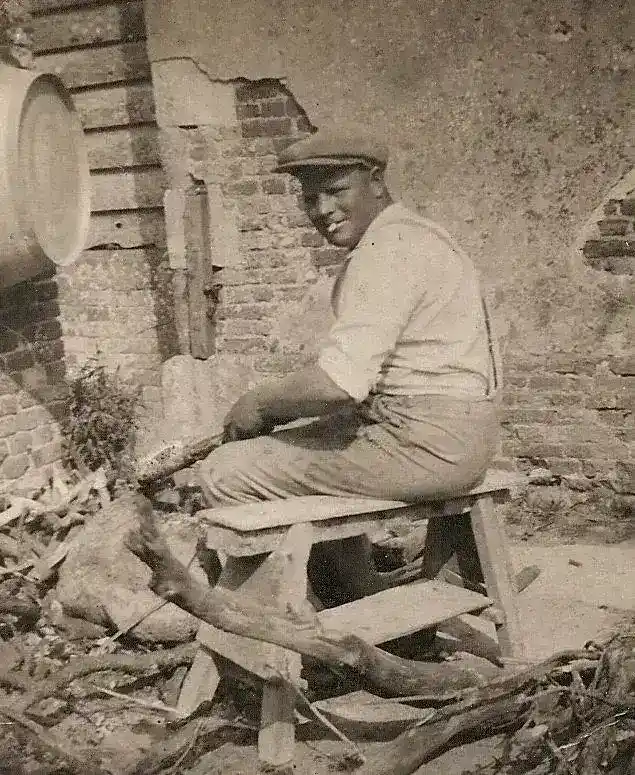
"I have to say I found walking through the barns quite eerie! Unlike maybe the church and the school — walking through the farm really does make it feel like everybody just upped and left in 1943."
The Tyneham Farm Project: 2008–2009
Tyneham Farm had been closed to the public since the 1943 evacuation. In January 2008 volunteers began clearing thickets of undergrowth and over sixty years of accumulated debris, and a community restoration project, the Tyneham Farm Project, took shape. The work was done largely by volunteers, and it uncovered surprises: removal of nearly a metre of silt from the site of the pond revealed a cobbled ford and a bridge opening built into the dry stone wall, the original course of the stream that had flowed over it.
Across 2008 and 2009 the project unfolded in public. A dry stone walling course produced its first wall in three days; a two-metre fence was raised to keep the deer out and the first of over twenty native species planted; volunteers laid a bridge, shifted tons of Purbeck stone, and built three gabion baskets. The History Barn itself was raised and refitted with two sets of new doors and eight clear roof panels that flooded the interior with light. A scented garden spread along the foundation of the old cart shed, and along its top ran the "Scrappy Wall", built from an eclectic mixture of Purbeck and Portland stone, bricks, slates, clay tiles, and custom-made gabion baskets filled with unearthed hinges, chains, bottles, and machinery parts, its top planted with thyme for the bees. Date stones set into the walls record the progress of each volunteer group.
What Has Been Lost
Beyond the farmhouse and dairyman's house, the hen house and bull house, which once housed what local records describe as a "Monster Devon Bull", no longer stand. The MOD, which manages the site as part of the Lulworth Ranges, demolished several of the more deteriorated structures in the decades after the war, a decision that has attracted criticism from those who believe the buildings could have been stabilised.
The stable block's original timbers are, according to those who manage the site, "literally rotting away", a reminder that conservation at Tyneham is an ongoing job, not a finished one. The MOD carries out maintenance work but has limited resources for full restoration.
Visiting the Farm
The farm buildings are open on the same schedule as the rest of Tyneham: weekends and school holidays when the military ranges are not in use, with the church, farm, and school exhibitions typically opening at 10am and closing at 4pm. From the car park, head south on the unmade road that leads through the trees towards the toilets, turn left, and Tyneham Farm is a very short distance beyond. Follow the lane past St Mary's Church and continue south for about five minutes. The Great Barn is clearly signposted.
The farm is roughly 300 metres from the main exhibition area in the church and school, so most visitors combine all three in a single visit. There is no entrance fee for any part of Tyneham: the car park operates on an honesty-box basis.
See Also
- Tyneham House — the Bond family manor and estate that the farm served.
- The Bond Family — the landowning dynasty who shaped the farm and village for 260 years.
- Tyneham Church — St Mary's, which stands between the village and the farm.
- Tyneham School — the other main exhibition on the visit.
- Visiting Tyneham — practical information including car park, access, and facilities.
Sources & Further Reading
- tynehamopc.org.uk — the official Tyneham information site, for the farm's buildings, farmers, and the Tyneham Farm Project timeline.
- Lilian Bond, Tyneham: A Lost Heritage (Dorset Publishing, 1956) — firsthand account of village and estate life including the farm and its dairies.
- Rodney Legg, Tyneham: Dorset's Ghost Village (Dorset Publishing, 1998)