Tyneham Church: St Mary's
By James Langton · Updated May 2026
St Mary's Church
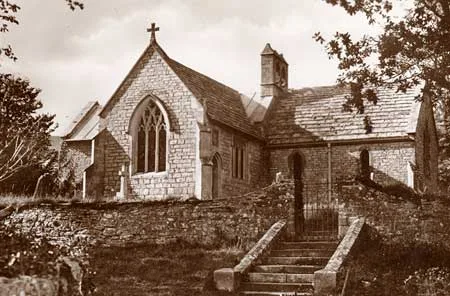
St Mary's Church may be small compared to many Dorset churches, but it served the villagers of Tyneham perfectly for centuries. Built mainly from local limestone rubble, the oldest parts of the building date back to around 1190 - making it one of Dorset's more ancient rural churches.
In the mid-19th century, Reverend William Bond rebuilt the south transept as a private chapel for the Bond family of Tyneham House. Outside in the graveyard, you can still find several memorials to the Bonds who played such a big part in village life.
The Bond Family Rectors
For nearly 150 years, the living at Tyneham was held by members of the Bond family themselves. Denis Bond served as rector from 1742 to 1795 - a remarkable 53 years. His successor William Bond then held the position for an even longer 57 years, from 1795 until his death in 1852. Nathaniel Bond followed until 1889. That three consecutive members of the same landowning family also served as the village's spiritual leader gives some sense of just how completely the Bonds shaped life in Tyneham.
The last rector, Reverend Humphrey Money, was not even in the village when the evacuation came. He was away serving with the Royal Engineers in 1943 when Southern Command requisitioned Tyneham, and he never returned to the parish he had served since 1937.
After the military requisitioned Tyneham in 1943, the church fell into neglect. Many of its fittings were removed and rehoused elsewhere - the bells and organ went to Steeple church, and the fine Jacobean pulpit was moved to Lulworth Camp.
Tyneham Church Today
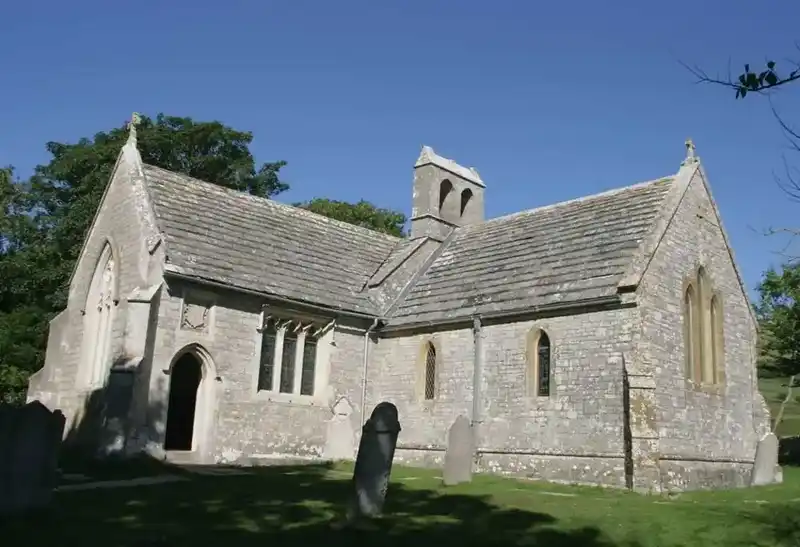
The church has since been carefully restored and now serves two important roles. First, it acts as a small museum telling the story of Tyneham - filled with displays, old photographs, documents, timelines and artefacts that bring the village's history vividly to life.
Second, it stands as a quiet memorial to the lost community. The names of former villagers are inscribed around the walls, and a restored Bible bears their memory. It's a moving reminder of the peaceful life that was taken away overnight.
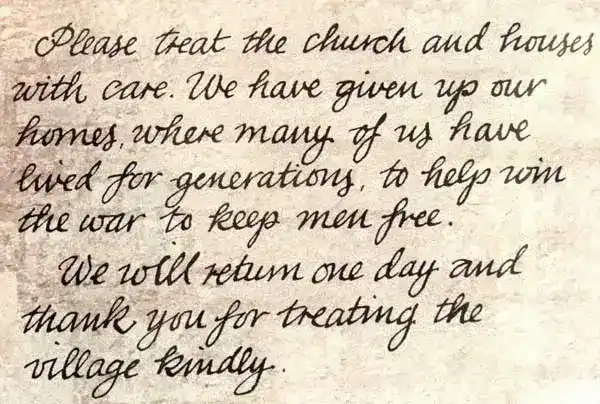
Perhaps the most famous artefact is the handwritten note pinned to the church door by the last villagers to leave in December 1943:
“Please treat the church and houses with care; we have given up our homes where many of us lived for generations to help win the war to keep men free. We shall return one day and thank you for treating the village kindly.”
Note that while the village itself is usually accessible on open days, the church and school exhibitions can occasionally remain closed for conservation reasons.

